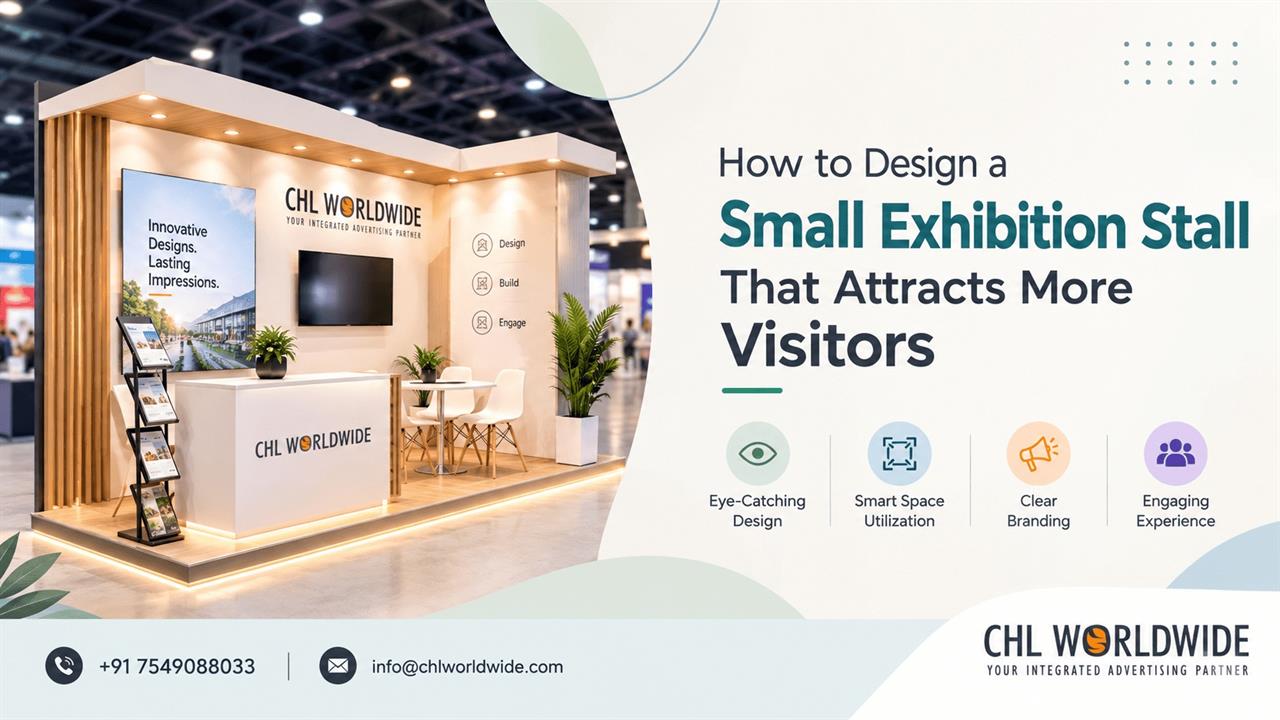
How to Design a Small Exhibition Stall That Attracts More Visitors
07-Oct-2026
Introduction
A small stall at a busy trade show can feel like a disadvantage before the event even starts. Limited square footage, tighter budgets and less wall space all make it harder to stand out next to larger neighbours. The good news is that small exhibition stall design rarely loses to size alone. With the right layout, materials and visual choices, a compact space can draw as much footfall as a stall three times its size.
What Makes a Small Exhibition Stall Design Effective?
Good small exhibition stall design comes down to three things working together. Clear brand visibility means visitors understand what the company does within a glance, even from across the aisle. Smart use of limited space means every fixture, display and walkway earns its place rather than filling space for the sake of it. Easy visitor movement means people can step in, look around and leave a conversation without feeling boxed in.
When these three elements align, a small stall design stops feeling like a scaled down version of a bigger one and starts feeling intentional. This is the foundation behind every attractive exhibition stall design built for limited square footage, and the starting point for exhibition stall design for small spaces of any size.
8 Small Exhibition Stall Ideas to Attract More Visitors
These exhibition stall design ideas work well for a creative small exhibition stall of almost any dimension, and double as practical exhibition stall ideas for small spaces more broadly.
- Build around one strong visual idea - A single bold concept reads faster than a wall of competing graphics and gives visitors something to remember.
- Use height to create visibility - Vertical signage and tall structural elements help a small exhibition booth design register from a distance, even in a crowded hall.
- Keep the entrance open - An unobstructed entry invites people in rather than making them hesitate before stepping inside.
- Create a clear focal point - One product, demo or display should draw the eye first, giving visitors an obvious reason to approach.
- Use graphics that work from a distance - Large, simple visuals communicate faster than detailed graphics that only make sense up close.
- Add interactive elements - A short demo or hands on display gives visitors something to do, beyond something to look at.
- Make storage part of the design - Multipurpose counters and fixtures free up floor space without sacrificing function.
- Design for conversations - Leave room for a team member and a visitor to talk without crowding the walkway behind them.
How to Make a Small Exhibition Stall Look Bigger
A few deliberate choices can make a compact footprint feel far more spacious than its actual dimensions suggest.
- Open layout - Fewer partitions and a clear line of sight across the stall make the space feel larger immediately.
- Less visual clutter - A focused message leaves room to breathe, which reads as spacious rather than empty.
- Vertical elements - Drawing the eye upward adds a sense of height and scale that floor space alone cannot.
- Simple colour and material palette - A consistent, limited palette feels more deliberate and open than a mix of competing tones and supports space saving exhibition stall design without looking bare.
- Visual depth - Layering elements front to back, rather than lining everything along one wall, creates the impression of more room.
How to Plan a Small Exhibition Stall Layout
A well-planned small exhibition stall layout starts well before the build, long before setup day.
- Plan visitor flow - Map how someone should move from entry to engagement to conversation before deciding where anything goes.
- Create functional zones - Separate areas for browsing demos and conversation keep the exhibition booth layout organized even in a tight footprint.
- Prioritize key displays - Give the most important products or messaging the best sightlines and let secondary material take a smaller role.
- Maintain open space - Resist the urge to fill every corner. Breathing room is part of good exhibition stall layout, rather than wasted space.
How to Attract More Visitors to a Small Exhibition Stall
Learning how to attract visitors to an exhibition stall depends less on size and more on a handful of deliberate choices, all built around engaging exhibition stall design.
- Make the message visible - Visitors should understand the offer within a few seconds of walking past.
- Create a reason to stop - A focal point, demo or striking visual gives people something to pause for.
- Use demonstrations - Showing a product in action tends to hold attention longer than a static display.
- Create a visual hook - A distinctive colour, shape or graphic helps the stall register against its neighbours.
- Offer a clear next step - Whether it is a sign up, a scan or a conversation, visitors should know what happens after they engage.
Small Exhibition Stall Design Mistakes to Avoid
A few recurring mistakes dim otherwise solid small stall design. Overcrowding the space with too many products or messages is the most common, since it leaves visitors with nothing clear to focus on. Blocking sightlines with tall furniture near the entrance keeps people from seeing what the stall offers before they even step in. Ignoring vertical space wastes an easy opportunity for visibility in a small footprint. Skipping a lead capture plan means good conversations never turn into a usable follow up. Designing purely for photographs, rather than how visitors move through the space, tends to look better online than it performs on the show floor.
Small Exhibition Stall Design Checklist
- Entry point stays open and unobstructed
- One clear focal point anchors the design
- Signage and graphics work from a distance
- Colour and material palette stays simple and consistent
- Storage and furniture serve more than one purpose
- Visitor flow is mapped before the build begins
- At least one interactive element is included
- A lead capture step is built into the layout
Conclusion
A small exhibition stall can hold its own on a crowded show floor when the design focuses on clarity, flow and one strong idea rather than trying to match a larger neighbour’s scale. Thoughtful layout, smart use of height and a clear visual focus usually matter more than square footage. The real goal lies in attracting more visitors to exhibition stall space that works harder rather than bigger. Exhibitors planning their next show can explore CHL Worldwide's exhibition stall design services to turn a compact space into one that genuinely attracts visitors.
LATEST ITEMS
OUR FAVORITES
30-june-2022
29-june-2022